Sunday, 30 January 2011

Task 3-What kind of media institution might distribute your media product and why?

Lionsgate would be the right institution to produce our film because Lionsgate is a nearly $2 billion diversified global entertainment corporation with a leading presence in motion picture production and distribution, television programming and syndication, home entertainment, family entertainment, digital distribution and new channel platforms. Lionsgate's blueprint for growth combines the flexibility and entrepreneurial culture of an independent, with the financial and strategic relationship of a major studio and the structure and consumer focus of a top digital age company. Therefore they would be the experts in producing low budget films like ours yet capable of producing a good quality under the genre of action/thriller.


Lionsgate produced films such as 'The Expendables', which proved to be a box office hit and therefore further established the insitution. 'The Expendables', is an action/adventure/thriller which follows a team of mercenaries who head to South America on a mission to overthrow a dictator. This is an example of the types of films Lionsgate produces, and this action/thriller/adventure genre is very similar to the genre of our thriller film.


So I believed that if they make our film, they would actually market the film by advertising through radio, television, Youtube, Facebook, and posters on buses and shopping mall.  In this way, my film would gain popularity through these form of advertising and the word of mouth. After screening, they could have make DVDs, Blue Ray and 3D version to help promote sales and also to keep the continuity in value chain.
They could also helped to produce video games through our film. Through the composers/ singers for our film’s soundtrack, our film could gain recognition as the audience are interested in the songs and therefore will feel curious about the film.


Lionsgate has also made investments in Break.com, the leading online site for young men ages 18-34 with more than 80 million monthly unique users worldwide. This is perfect because our main target audience young men and this will be a great opportuinty to promote our film. We will also distributing to the film festivals because I think it will help raise awareness of the film and hopefully through positive word of mouth, it will gain more popularity, more audience and more profit as an outcome.


Saturday, 29 January 2011

Task 2-How does your product represent particular social groups?

We have the most screen time for one character, therefore he is the main character and I will be analysing on. In the beginning we see that he washes blood off his hand and looked at his face for a while before getting to change. This shows that he cares about his looks or conscious about his image. This is shown again later when he was fixing his tie and it reinforces the the main idea of our action/thriller which is different identities changes.


There are mystery to it as it makes the audience to feel curious about him being under the secret mission or undercover of some government conspiracy act.
So this helps to build his image as a cool handsome guy with a good body and that all the girls who drool over for. I see his character like Brad Pitt or Danial Craig who have a big franchise in his action films.

Our particular social groups are younger men age group  from 15-34 who are preppy, jocks, cool and smart who enjoy adventure with solving mystery. It will also be guys who are conscious about their looks and their bodies so they would have the main character as their idol or role model to look at to feel good about their appearances.


Task 1 - In what ways does your media product use, develop or challenge forms or conventions of real media products?


First of all, we used the darker coloured scheme throughout the opening sequence to denote that this film is a thriller genre.  The picture of a gun in the left hand corner represents danger and it helps to convey the idea of the film being an action thriller. Immediately, targeted male audience would be fascinated by it and would want to see it.

Second picture is a door handle, which signifies the idea of being trapped and that there is a mystery about it. This helps to conform our opening title sequence because there is unsolved situation leading into a mystery and this mystery is an element of a film thriller.

Third picture clockwise shows that convention of a thriller. The picture of the tap is important because it conveys the personality of the protagonist who is cleaning his hand. It tells the audience that he felt sorry, he is also cleaning his soul or guilt in a metaphorical way. This leads to the picture below it, which is a picture of blood being drained, which is informing that someone is dead. Blood represents danger and once again we highlighting the genre of the film by conforming the convention of a thriller.

In the centre is a picture of a protagonist in a close up shot to convey his expression of fear(convention of a thriller) which juxtaposes to his character and his outward appearance. He is a stereotypical of a hero figure who is good looking and smartly dressed like James Bond; however his inner emotion is also discovered and left open for the audience to see it. This is a juxtaposition of his real image and his outward presented image. This is linked to the first picture on the left in the third row where he saw his own reflection from the mirror represents that his outside and inner self.

Lastly,  the picture of a safe and a photograph portrays that he in a house (someone else’s) and once again conforming the mystery element t

Wednesday, 26 January 2011

Account of the shoot day


My group and I went to Cornhill (boarding house) to shoot as planned. We chose this particularly boarding house because it is one of the nicest boarding house and the rooms are much bigger compared to other houses like Hurtwood House. It is appealing for our shoot because it is perfect for our set as we wanted to have a feel of home-like, private house setting as the main character is at someone’s house. During the journey to he house, we explained the idea and how we want to shoot to the actor first. So that he understood what he needed to do and how we wanted him to be.

As soon as we have arrived, we set up the tripod, camera and lighting set. We also ensure that we brought our props; black suit, black trouser, black tie, pale yellow colour shirt and a bottle of fake blood to the set. We were using at my team mates’ room, so they actually took down their posters of Megan Fox and others in order to make the room more realistic and fit into the plot of the story because the room is meant to look like a middle-aged married couple’s room. There weren’t any Queen sized room so we had to combine two small beds into one and then covered it with a big duvet to make it appear as a big double queen sized bed.

We did not shoot according to the storyboarding in a chronological order because we prioritise on the most crucial shots which was in the bedroom. Besides, most of the shots were mostly set at the bed room. Before we start shooting anything, we have the camera bubbled (have the bubble in the middle) and white balance. To ensure on what we are filming was a good quality shots, we zoomed an object to the max and then slowly turned to have it focus, then zoomed out. Finally, we started to shoot. We have this routine every time we shoot for anything.

We began to film over the shoulder shot of him opening the cupboard and taking nice suit out. While we did that, we have to say ‘cut’, ‘action’, ‘standby’, ‘rolling’ and this was usually done by the person who is taking in charge of the camera. As we took turn to shoot, we had to say them and it was actually fun as it placed you into role of a director’s position.  Once we finished it, we tried something different which was not listed on the storyboarding. We decided to shoot him doing the same thing from the closet ‘point of view’. So the lighting was slightly darker which helps to highlight the mystery thriller moment for the audience.

Straight after the first shoot, we have a shot of him putting the suit on the bed and started to wear them. This was the part we spent most time on as we had different angle shots of him doing the same time. So we had a shot of him from the side, from the front  and from a high angle and low angle point. When we shooting from the side, we had to be extra careful about what was on the background. For example, we weren’t aware of a dustbin at the background until we saw it on the screen. So we had to quickly remove that away and re-shoot that scene. It was lucky for us that we managed to recognise our mistake immediately. So it brought us into an awareness of how important it is to be concise what was in the background because little mistakes could cause the whole filming into ruin.

When it comes to filming the actor quickly putting his trouser to get dressed, we speed up the shutter speed to make the audience feel his urgency and his nervousness to escape before he gets caught. This is what we want the audience to feel as we want the audience to see this opening sequence from his point of view. When we have shutter speed to increase higher, we could see the effect of the moving image being quickened which we were very pleased about.

Another interesting filming technique which we learnt during our filming process was ‘zoom and focus’ trick. We have our actor kneel on a chair (he was too tall) to align with the gun on the table, this is to show what he was thinking. To show that, we just filmed the length between
his shoulder to his head, and the gun was not focused. As he turned towards the gun, we have the gun being focused. This was brilliant as it would create suspense for the audience.
To create further tension, we jerked the camera a little bit while we were shooting.

After shooting the bedroom scene, we went to the next location to shoot for the different scene. We had to use to a different bathroom because it was slightly bigger. We have the fake blood ready for the shoot. Before we start to shoot this scene, we tested the fake blood to see if it stained. We did this because we did not want to have the actor’s hand yellow after he washed his hand. We wanted his hand to be completely clean. This helped to show the contrast between his hands covered in blood and after her washed it.  To help save time, we did several tasks at the same time. While I was testing the fake blood, my teammates were setting up the camera and white balancing. The actor had to take his top off to make it more real and logistic. This scene was meant to be an earlier scene.

So we poured the blood on his hands and then started filming him opening the tap water to wash his hands and then his face. For this shot we did not use extra lighting as the toilet’s lighting was just perfect for the shoot. We had to film on the right side, we did this specifically because we did not want to have the toilet in the shot. After shooting it, we had a shot of just blood running in the sink. We had this shot zooming in because we want to specify the genre of our opening sequence ‘horror, thriller’. Also, red blood does help to accentuate the mood of shocking, terror in the audience.  So we were very pleased about those shots. After shooting it, our final shoot was to shoot a shot of a door handle turning slowly.

One final task we did before we finish packing was to record the sound of walking up and down the stairs. We might use the non-diegetic sound for the shot where we see him dressing up in a hurry.

Overall, we were very pleased with the shooting. It took us about 3 hours to complete the shooting. We were very efficient and worked together as a group as we aimed to produce a good quality in the thriller. The actor too was good at acting and very easy to work with. We had no problem at all with him as he did exactly what we told him to do and he perceived our idea, there present brilliantly in front of the camera. I am pretty sure he enjoyed filming with us especially when he had to take gun and put it at the back in his trouser. He looked cool and he felt cool too. It was great day.


Main Task shooting schedule       Locations                              Cast               Props and Costumes
21st Jan 2011
Friday - 9am - 1pm                      Cornhill boarding house       Jake Cecil      Gun,British Passport, smart                    
                                                                                                                        suit, black tie, bottle of fake                                                     
                                                                                                                        blood.


Final Idea

After going through so many ideas, we have decided to go with the idea of action-thriller opening sequence   . Soon our idea began to develop into different shots which reveals about the man who steals the identity. Although our idea is a very simple as we are shooting a man changing into a new set of clothes but our idea creates many different ways of interpreting it. There are many possibilities of him could be the killer, the son, the ex-convict who tries to justify himself or stealing identities to cover his crime.

Storyboard for the final idea


Wednesday, 12 January 2011

New idea!!

While we were looking for props, and locations to finalised our idea and be prepared with storyboard, we found two new ideas because we were not very keen on the previous idea which we settled with. During the hols, we had communicated with one another via email and Facebook to discuss and finalise our idea. My teammate dilligently put up two Powerpoints to discuss about the mood for thriller and how we should put this basic idea into the filming process.

Here are two powerpoints :


At the end, we as a group came into an agreement that the second PowerPoint would be a better idea as it is more original whereas the first one is a little like Se7en.


<iframe title="YouTube video player" width="480" height="390" src="http://www.youtube.com/embed/SEZK7mJoPLY" frameborder="0" allowfullscreen></iframe>

Thursday, 9 December 2010

My Second Horror Thriller Idea in Power Point

We were very impressed by the ideas used for the opening sequence of Se7en and Momento. So we wanted to create similar version of it.  Nevertheless, our ideas became unoriginal and there was not a proper storyline to it.


Due to musical rehearsals and falling ill, I was absent for several media classes. Therefore, I missed out the discussions with my teammates. However, I managed to receive a brief information on what has been happening in the class.  Despite all that, I came with an idea where we could use a similar style of Momento.

This is my powerpoint presentation:


Unfortunately, it was turned down. So it was not very original. In addition, they wanted action and fighting. So we had to come with another idea.
 At last, we are finalised with our idea. 

Wednesday, 8 December 2010

Group Horror/Thriller Ideas

During our first meeting, we each shared our ideas to each other and finally decided to use Imogen's idea.
We were aiming to create mystery, fear, and spooky atmosphere to the audience by using a doll, a young girl, an old shady house, a playground and the swing. We chose these because this amplify the theme of the opening sequence: horror/thriller.
  • a small girl in a park on a swing
  • a woman watching her
  • flashback of woman pushing her daughter on the swing
  • woman looking at the photo of her daughter to indicate that her daughter has died)
  • woman putting 'wanted poster' through the little girl's letter box
  • little girl turns up at woman's house and we see that woman is going to kidnapp her.
After a while, we realised that it is not a good idea to develop further because it is too long to fit into the 2min opening sequence and it would be difficult to find a little girl (6-8 year old) for the part. It will be unrealistic to use 16 year old teenager to play for it. 

We then brainstormed some ideas and Isabel came up with a total different idea and we got the inspiration from  
Organ Theft.
"Dammit, that's the second time this—wait a minute..."

"Aww, they took my freakin' kidney!"

Organ Theft, as the name would imply, is the practice of stealing people's organs via surgery, which can then be used for further purposes such as transplants or sold on the black market  * One particularly common variant of this is trope is the "kidney theftUrban Legend, in which the victim is conned somehow and drugged into unconsciousness, and then wakes up kidney-less in a bathtub full of ice, often with a message attached telling them to go to a hospital.
This trope was popularized by, and originated with, Larry Niven's Known Space stories, in which Organ Theft is called "organlegging", a portmanteau of "organ" and "bootlegging." 

So this is the idea which we came up with:
  • There is an extreme close-up of a girl's eyes. We see them open as she gasps.
  • There is then a reverse zoom so we can see that she is in her underwear in a bath full of ice; she has a shocked/confused expression.
  • There is then an eyeline match of her looking in the mirror. We see that there is something written on the mirror. The rest of the mirror goes out of focus and allows us to read what is written in red lipstick: 'call 0800......( a phone number)'
  • The girl looks around and sees a phone lying next to her. She slowly types in the number and we see a close-up of the phone with the diegetic noises of her typing in the numbers.
  • she puts the phone to her ear, but we don't hear what the person is saying on the other line. She has an extremely shocked expression and slowly lets go of the phone in fear.
  • There is then a flashback. We see her dancing in the club holding a drink, she moves over to dance with a guy and when she's not looking there is a close up of him spiking her drink. We then see him dragging her into his car or something similar to this to show that she is the victim and he is the bad guy.
  • It then cuts back to reality and she is in the bath. We are looking at her through the mirror. She looks down looks back up at herself in the mirror and screams.
  • The screen goes black and the title comes up whilst she is still screaming.
We wanted to create something that is quite real as it has happen in the rural places before and kidneys are sold at hight cost. Through this idea, we are also conforming to the genre : thriller. 
It was a brilliant idea and no one has ever done it before ; It is new and fresh. However, we faced some issues regarding the girl being shot with bra but resolved that we use a guy shirtless instead and he being conned by a sexy girl from a club. We might also need to hire a make-up artist to make the the stitches believable. In order to film in a club, it requires for our group to write a permission letter for approval both from the Principal and the owner of the club. After several discussions with our teacher and staffs from the media department, our idea was rejected.

Analysis of the opening sequence of a thriller ( Scream, The Shutter Island,

Scream


In the opening sequence, we see a lady alone in the house and this we expect to see her as a victim and she could be in danger.  In this opening sequence, the lighting is yellow orange colour which represents that she is danger. We have a wide a shot of her talking on a phone and quick cuts between her and the popcorn heating up  to reinforce that she is danger.  We also have see a mid close up shot of her to show her facial expression  which juxtaposes later with her feeling really scared about this stranger who turns out to be a killer.We hear their conversation of them talking about horror movies which suggest that this film's genre is under thriller/horror film. The tension is gradually developing for the audience as we begin to see an establishing shot of her boyfriend being killed outside of her house . Her being in the house and watcing her boyfriend died  signify that she is on a weaker side where she does not have the availabilty to help him. This also suggests that she herself is trap inside her own house. The mystery killer is in control and that she is the victim.


The Shutter Island


 In this opening sequence,  We see two people dressed up in a big trench coat which were brings out the stereotypical image of detective which immediately tells us that there might be a murder or something have happened and that they need to solve it.  We then see a point of view shot of them looking over at the people the other side who are waiting for them. They are dressed in police uniforms with guns which suggests that the place is a dangerous place.  This is highlighted again when we see a close up shot of patiens in chains to show that that particular place is dangerous. From this we know that this film involves horror.

Monday, 6 December 2010

My initial thriller ideas


First, we have a close up of a round clock hanging on the wall showing its twelve o’clock and then dissolve to a close up view of the red rounded house telephone to signify danger. During these shots, we have synchronous sound of a clock ticking and the telephone being press slowly producing ‘err..rre.er…’ sound.

Suddenly we hear someone banging the door. From then, we have clock ticking really fast and we see a close up of the red phone winding really quickly. As it is winding quickly, we have a very quick montage of a tray of surgery tools (knife, scissors, and tweezers), a hand with a white glove holding a knife which is covered in blood, we see a victim’s hand and legs and lastly we have a finger with long black nails stopping the winding of the telephone.

During this sequence of the montage, we have the non-diegetic sound of whispers and talking and it all stopped when the telephone stops. It ends with in black and the title shows in white- grayish ink ‘The Cycle’. For lighting, we have a very dim light for the clock and a very dark lighting for the red telephone. For the montage, we have yellow lightings.

Wednesday, 1 December 2010

Narrative theories in thrillers

Most of the thriller films often follw the 5 forms of narrative structure and they are assembled in this order:

EQUILIBRIUM =>DISRUPTION=>COMPLICATION=>RESOLUTION=>NEW EQUILIBRIUM

A good example would be Jaws:


  • Equilibrium- Normal sunny day at the beach playing and relaxing, everyone is preparing for the 4th of July celebration

  • Desruptive- Find pieces of the dead body ehich had been eaten by shark.

  • Complications- Does the beach close or remains open? Is there really a shark? Another person dies. Are there more deaths?

  • Resolution- The beach is open and they decide to look for sharks.

  • New Equilibrium- Shark and shark hunter are killed. Everything returns to normal but there are slight changes because people in the area are affected by the cause.
Characters
There are particular set of five characters in the film according to Vladimir Propps Theory:
  1. The Hero                   -  the one who saves the day
  2. The Villain                 -  the evil one who causes disequilibrium
  3. Side Kick /the Helper-  a person who helps the hero.
  4. The Victim                 -  at the mercy of the villain
  5. The Donor                 -  someone who has something special which will help the hero.
We can see it in film like Harry Porter:


  1. Hero       - Harry Potter
  2. Villlain    - Voldermort
  3. Helper    - Ron and Hermione
  4. Victim    - Serius Black
  5. Donor     - Dumbeldore

Conventions of a horror/thrillers

In class, we brainstormed and listed the various conventions which we expect to see in horros/thriller films.
  1. ghosts
  2. death
  3. mystery
  4. water
  5. bad reather (thunderstorms/raining)
  6. contrapunctal sound
  7. animals (snakes/cats/rats)
  8. insects( coakraches/spiders)
  9. blinding headlights
  10. fog
  11. paranoia
  12. basement/store room
  13. blood
  14. bathrooms
  15. mirror
  16. weapons (knives/saw/scissors)
  17. dolls
  18. clowns
  19. clock
  20. pale skins
  21. power cuts
  22. demons
  23. monsters
  24. vampires
  25. zombies
  26. graveyards
  27. dead body
  28. forests
  29. kitchen
  30. old house
  31. attics
  32. floorboards
  33. doors
  34. screaming
  35. isolations
  36. windows
  37. suspense music
  38. eerie music
  39. silent
  40. whispers
  41. car breakdown
  42. claustrophobia
  43. children
  44. bedroooms
  45. bath tub
  46. dark long hair
  47. white robe
  48. dark robe
  49. protagonist
  50. antagonist

Tuesday, 30 November 2010

Mood Board

Mood board
Below  are the objects which  I am fear of.

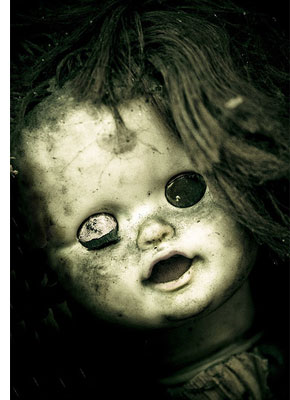
Dolls
Travel Blog: Island of Dolls, Mexico" title="Travel Blog: Island of Dolls, Mexico
I am scared of dolls espcially if it is at night because their wide eyes and it feels like they are watching me.

Mirrors

I am afraid of mirrors as I always imagine that there might be someone in the mirror who could pop out or I might see something which is really ugly and terrifying.

Shadows and darkness
I am also afraid of the shadows and darkness as I could not see properly and  I would have scary thoughts spirits walking around.

Clowns
Lastly, I find clowns very disturbing and it scares me because of their make up and their mischievous behaviour

Friday, 19 November 2010

Connotation and denotation of horror films

The Scream


Denotation:    The girl is on a phone outside of her house and then we see guy in a mask holding a  
                     knife.
Connotation:  She could be calling someone for help, she is also in danger and the villain is
                     trying to kill her.

Gothika

Denotation : The back of a woman in a blue hoodie with blue pants is looking at the red colour writing 
                   'Not alone' on the wall.
Connotation: Red paint could be blood and that she could be in danger. Creates mystery and suspense and   
                    she is trying to find out who has written it.
Exorcist

Denotation :  A girl with with yellow eyes and messy hair. She has scars pn her face and her teeth is rotten.  
                    She is in her blue pyjamas.
Connotation: She is possesed by demon and she perhaps have eaten or bitten some human beings. She could
                    be slashed by a villain and it happens at night. She was a victim herself.

Just by looking at these three still images, I noticed that many of the victims are women and many of the ‘villains’ are male and they are often cast in a mysterious way. This creates the audience to feel anxious about who the killer is. Another common thing we see from thriller, horror movies is that the camera work which is tilted image. The effect of having a tilted image is to have show the audience is have a chaotic and building a distorted style.

Tuesday, 19 October 2010

Preliminary task evaluation


The video we made:


Prelminary Post Production

Finally, we learnt how to use Final Cut Server in our lessons. Final Cut Server is . Final Cut Server is a computer programme created by Apple Mac to put together shots to produce a film Final Cut Server is a computer programme created by Apple Mac to put together shots to produce a film.

The process starts with uploading our clips onto Final Cut, then watching them to find the ones with mistakes or tthe clips which fitted our sequence best. all the best clips were put into a log bin, the log bin helps to separate the clips as well as on an organisation level, as having this folder makes the clips easily acessible.  it was important that we chose the better shots, as because it was our first trial of filming, there was obviously going to be lots of mistakes. So we tried to cut down some clips with background noise or extra talking, to make the scene lookk more professional. this helped us to find the best fitting cuts to build a scene which really worked.

continuity editing. I had to ensure that the scene made sense and flowed well. I also had to remember to fit the sound over the clips in the correct moment otherwise it didnt fit. Then I had to choose the most relevant shots, to build a scene and to help the film flow smoothly. This was to manipulate time and space in the narrative. I then had to put together the most appropriate shots to help the audience to side with the protagonist and the antagonist. The shots have to appear in a particular order, so that the audience can have some background understanding of the scene. My film showed this, by showing the antagonist walking along into the room, opening the door then closing it behind him. Then the protagonist was sat in the same room, which the antagonist later enters, holding a gun. Just having this simple 30 second clip, tells the audience that the man is the antagonist, as he looks threatening. Then the audience understands that he is dangerous. Just as the woman is sat holding a gun, this gets the audience to think, whether she is the antagonist as she is going to shoot the other subject, or she is perhaps the protagonist because she is protecting herself with a gun.

After this, each of the special chosen shots were put onto the storyboard. the storyboard worked as a timeline which would fit each of the clips together. Once we had dragged them onto the story board in the correct positions, we had to make sure the background sound was in time with the movement of the shots. In my sequence we had more screen time on the protagonist as we wanted to highlight how she is good and how her reactions are important. Then the antagonist had less screen time. Although, in the editing, we made the cuts between each of them fast paced to show tension between the charcters. With a few single screen shots of the revolver, highlighting again the danger within this scene.

The overall editing turned out very well. The scene looked great in the end. But I noticed as we were watching it through that I had left a flashframe. This means there was a second where the scene goes black inbetween scenes.This means that the clips are not directly next to each other. Therefore I had to go back and pull the clips closer together. It is very hard to notice, but through the eyes of an expert its very obvious. If I had just left it, it would have looked like very poor editing.

Overall I really enjoyed using the programme and now that I have learnt from my mistakes it will be a lot easier to use. But it is a very useful prgramme and I will definitly be using it in the future.
One last thing to remember was to APPLE SAVE so that we would not loose any data or any editing which we did.


Preliminary task

After learning how to set up the camera and learning different types of shots in theory , we were divided into groups to use it. It was a good experience for us because we now have a little knowledge in handling the equipments.

There are 4 in my group: Holly, Immie, Miran and myself (Honey). We were then given given a scenario where someone walks through a door, says some dialogue to the person in the room and then walks out again.
This is the scenario we were given:

However, we could use this idea as our basic idea and we were asked to develop on it. So we used my idea with some changes. So the storyline was that the main character was possessed by demons and he was killiing and destroying. So he came rushing through the room where his girlfriend ( who was holing the gun for protection) was and asked her to shoot him but she was frightened and did not want to shoot him. He would kill her if she does not kill him, so she does not have a choice. At the end, he was shot dead.

Before we start to shoot, we had to do several things first:
  • Find two actors
  • Adjusted the tripod to the right height
  • Bubbling the tripod to make it level
  • Attatched the camera to the tripod
  • Open the shutter on the camera and turn it on
  • White balance the camera by facing it towards a white surface
  • Adjust the shutter speed
  • Focus the camera
Among the four of us in the group, we shared the work equally for the shoot to be successful.
Holly   - who did the shooting
Miran  - helped with the lighting, camera angle shots
Immie  - control the lighting
me       - directing

Aside from Holly who had to control the video camera, Miran, Immie and I helped around to move objects to ensure that it will be a continuity editing and be more realistic. I learnt that it is important to be in detail when filming, otherwise it could ruin the film as it is not in continuity editing.  During the shooting, we used the terminology such as 'Cut', ' Action' , and 'Stand By'.

Overall, I enjoyed being on the set helping and directing as I understood better about 180 degree rules and how important it is to have 'white balance' before shoots as it could ruin the colour in film. I really enjoyed working with my group because we were all working together as a unit and it makes our shooting much easier and faster.


              This month I learnt how to set up and how to operate the camera the correct way. I use  Sony DSR PD-100A to learn how to use it.
 First of all, we learnt how to set up the tripod and we had to ensure that there is bubbling. This shows that it is ready to use. It is important to have the bubble in the centre. It is important to have tripod as it helps to take shots smoothly and not shakey at all times. It allows to use different type of continuity shooting such tracking shot, tilting and pan shot.

We are told not to record video tape at any speed other than Standard Play  as MiniDV digital tapes hold either 63 or 83 minutes in Standard Play. A standard "T-120" or two hour VHS tape holds 120 minutes of video -- two hours recorded in the Standard Play mode.  I learnt that there is an imprint of date/time on the camera. Once this information has been imprinted on your tape, it cannot be removed.


The date and time will be on during the shoot unless it is turn off before shooting! Most video cameras have a zoom lens, which enables you to go from a wide angle view to a close up at the push of a toggle. If you intend to edit your video tape, using your zoom toggle is o.k. You'll need to use the zoom to change the apparent distance between you and your subject. Once you've zoomed in or out, video tape the scene for at least five to ten seconds before going on to your next shot.
If you don't plan on editing your video tape, zooming may be necessary to make a transition between shots. If you must zoom, zoom slowly. Start with about five seconds -- a slow "one one thousand, two one thousand" -- during which there is no movement, then zoom in or out at a speed which is virtually imperceptible. Many cameras have a combination of optical and digital zoom.


Here is the reference to different types of camera shots and camera movements


White balance
 My group and I tried to zoom in and then out as it helps to focus on the object which we are shooting at. I learnt that white balance is really important because it ensures  that the colours are reproduced accurately. To do 'white balancing', we must manually do a white balance every single time your change from one light source to another. Otherwise, the camera will think that white is what it saw under florescent lights when you are shooting in warm sunny summer sunlight.
Exterior -> Daylight –>  cool, blue
Interior ->  Tungsten –> warm, orange
Without white balance           With white balance
I learnt that I have to becareful with 180 degree rule as I am often not careful about it and it will not be ilogical for the audience to see it. The 180° rule is a basic guideline in film making that states that two characters (or other elements) in the same scene should always have the same left/right relationship to each other.
                                                                                            

This schematic shows the axis between two characters and the 180° arc on which cameras may be positioned (green). When cutting from the green arc to the red arc, the characters switch places on the screen.

It  enables the audience to visually connect with unseen movement happening around and behind the immediate subject and is important in the narration of battle scenes. Avoiding crossing the line is a problem that those learning filmcraft will need to struggle with.

My teammates Holly and Amy were constantly aware of that during our first task of shooting the given basic storyline and shots such as two shots and over head shoulder.

Lastly, we use industry terminology whilst filming so that we don't waste time and helps everyone to comprehend what to do.

Stand by/ standing by-
 Prepares everyone into position for the take. The AD calls Stand By and the response tells them that everyone is prepped.

Turn Over/Turning over-
The director tells the camera operator to start filming. A few seconds of film is then run as the camera gets up to speed and this is often referred to as Lead IN. Once it is done,the camera operator will respond Turning Over  or rolling to indicate being up to speed.

Action!                              -
Cue the actors to perform the take, and the crew to do their jobs. It is a good practice for director to let the film run on a further few seconds after the take is completed before cutting. This is referred to as Lead Out

Cut-                                
Cue for the actors to stop running the film. Industry practice expects that the camera operator does not Cut being told.

In order to help us shoot with specific shots ('close ups', ' medium wide shots' and 'establishing shots'), we learn different types of camera shots in class first.


Rule of ThirdsProper framing

The first thing to learn is how to frame your subject.  If you’re a still photographer you’ll already know about the rule of thirds.  This works for filmmaking as well.  Notice the website below. 
The rule of thirds:
This is a general principle in photography, which is generally considered to make shots more appealing to the eye.  One can easily visualize this rule by taking a frame and dividing the horizontal piece into three equal sections and dividing the vertical in three equal sections.  This creates 9 equal sections.  Where these sections meet are four points on the frame.  By aligning the central object into these points of the frame (often called the power points), instead of centering the object, you get more aesthetically and professional-looking shots.
However, we should note that while we describe this as the RULE of thirds, it might better be used as a guideline. 
Common uses of this rule in video are:
  • Framing an interview: The eyes of your subject should fall in one of the upper powerpoints and the subject should be looking towards the empty space on the frame.
  • Shooting a horizon: Rather than position the horizon on the center of the frame, align it along the upper or lower third depending on what you want to emphasize.  For example, if you’re shooting a cloud time-lapse you will want two-thirds of the shot centered on the sky.

Basic Camera Shot types:

Extreme Wide Shots (EWS) act to establish the area.
Wide Shots (WS) show the entire person or area.  They’re great for establishing the scene and allow for good action of the characters.  Sometimes this is known as the long shot.
Medium Shots (MS) frame the subject from the waste up.  This is the most common shot and allows for hand gestures and motion.
Medium Close Ups (MCU) shots show the subject in more detail and are often framed from just below the shoulders to the top of the head.
Close Ups (CU) show a particular part of your subject.  For people this usually means the shot frames just the head!
Extreme Close Ups (ECU) are much tighter close-up shots in which you get detail greater than the human eye might be able to normally perceive.  An example of this shot might be of the mouth and eyes together
Camera Shots and Angles

Advanced Camera Shot Types

Two Shot: This is a shot of two peoples (or other individuals) together. 
Cut Away (CA): Cutaways are used in the editing process to fill in footage which is different from the main action.  B-roll is often used for cut-aways.  An example might be a cut away of a bird singing if the shot is focused on a couple in the woods. 
Over the Shoulder Shots (OSS) are shot from behind the person towards their subject.  Generally the frame is cut off just behind the ear, although there are several variations.  A good technique to use to get this shot is to frame the person facing the subject with about one third of the frame.
Point of View (POV): This is an effective shot that gives the audience the feel that you’re seeing it from the eyes of the performer.  It is taken from near the eye-level of the actor and shows what he might see.  It could be used to give the perspective of other animals too like a frog, a bird, or a fish.
Selective Focus: By using a large aperture value (f/1.4, f/2.0) you will be able to create a shallow depth of field.  This effectively leaves one part of the frame in focus while blurring others, such as the foreground or background.  When you change the focus in the shot from the foreground to the background you’re doing another advanced camera shot called a rack focus.


What is a thriller?

In our lessons we looked at the film 'The Usual Suspects'. We studied the camera, lighting and mis-en-scne of the film. we also discussed what constitutes a thirller...

  • There is usually a twist in the plot.
  • A hidden identity within a charcter.
  • Lots of violence
  • Good verses Evil. A 'good' guy and a 'bad'guy.
  • Flashbacks, to reveal previous information to the story, or to the crime.
  • Added audience information.
  • Dark lighting
  • Murder/Corruption
  • Deep, heavy drmatic music.
  • Criminals and Police
  • Death
  • Mystery
  • Lighting such as ambient - natural light, low and artificial, usually designed for the film.
  • Low or high key lighting depending on what type of film your watching. (Film Noir)


Also in our lessons, we denotated and connotated the main promotional image.
we picked up on things such as 
  • 5 men in a police line up.
  • All dressed differently
  • One is in a cream suit
  • They are all various heights
  • No one is smiling
  • Man on the end is grsping his arm
  • Man dressed in leather has an agressive stance.
  • Horizontal lines behind them
  • Tallest man is in the middle (pyraid lik,e shape)
  • Red font title
Connotations for the Denotations
  • Police line up, signifies there in trouble.
  • They are all in the same situation, as they are all stood together
  • The cream suit guy, looks different to the others.
  • Lighter coloured suit symbolises innocence.
  • Red font represents danger
  • Holding arm for discomfort.
  • Pyramid of Power ... Hierachy between the charcters.